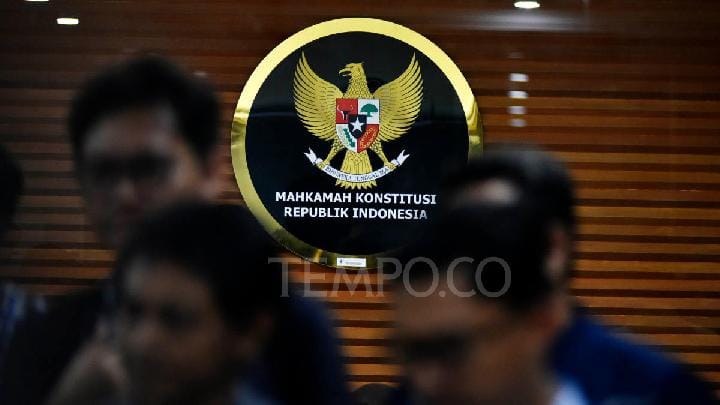
The DPR opted to appoint constitutional justices from political parties, a move rife with conflicts of interest.
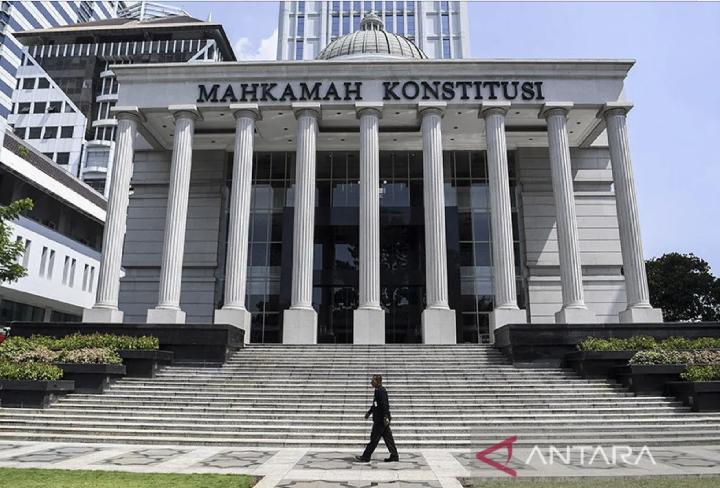
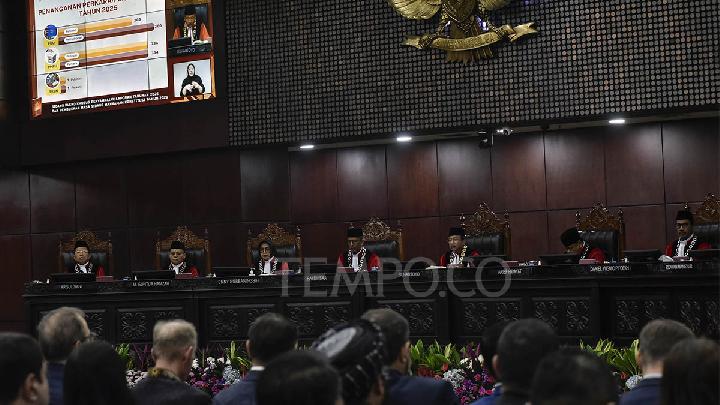
POLITICIANS have never allowed the Constitutional Court to function as a truly independent institution. They consider the institution established after the 1998 Reformasi to be an obstacle if it is allowed to carry out its original mandate. Today, the operation to weaken the Court comes from the House of Representatives (DPR).
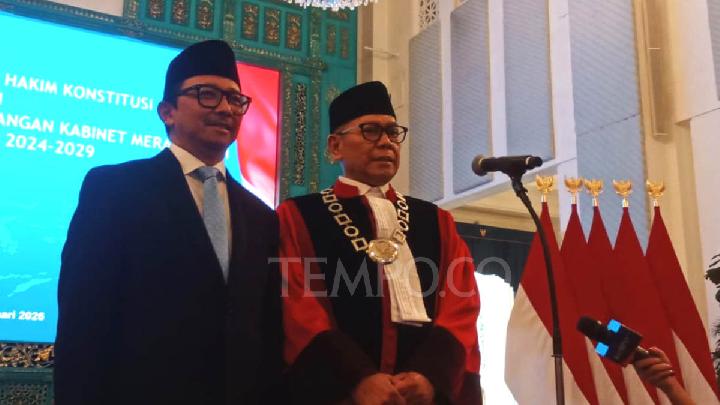
This maneuver takes the form of nominating Adies Kadir, a Golkar Party politician, as a constitutional justice. By law, the DPR, the government, and the Supreme Court each nominate three justices to fill the nine seats on the bench. Since 2025, however, the DPR has fortified its grip by introducing a clause allowing for the removal of justices mid-term through a mechanism labeled “periodic evaluation of officials elected via fit-and-proper tests.”
Adies became a controversy after misrepresenting legislative allowances, an error that sparked public outrage and culminated in mass demonstrations in August 2025. His nomination is no less contentious. He appeared suddenly, replacing Inosentius Samsul, a candidate who was abruptly withdrawn by the House. Adies carries a potential conflict of interest, given that one of the functions of the Constitutional Court is to handle judicial reviews of laws produced by the DPR.
In 2022, the DPR dismissed Justice Aswanto after he and four other justices ruled the Job Creation Law conditionally unconstitutional. The House argued that Aswanto deserved the boot because his rulings struck down products of the legislative body that nominated him. However, constitutional justices are not seated to represent the interests of their nominators. They are not extensions of the House, the government, or the Supreme Court.
The withdrawal of Inosentius Samsul, the former Chief of the DPR Expertise Body who had effectively already been selected as constitutional justice, is inseparable from the interests of his nominators. He was reportedly replaced because of his reluctance to pledge protection for the DPR’s interests within the Constitutional Court. Rather than improving the quality and process of lawmaking, the DPR seeks to prevent the annulment of legislation through the placement of loyalists.
The effort to control the Constitutional Court has been long in the making. The DPR has revised the Constitutional Court Law three times, tinkering with articles on the minimum age for appointment and term limits. The attempt to prevent judicial independence has been “systematic, massive, and structured.”
The Constitutional Court had, in fact, been trending toward a positive trajectory. It recently produced several rulings aligned with democratic principles, including restrictions on police officers holding civil service positions. These decisions had begun to restore public trust, which collapsed following the controversial amendment to the age limit for vice-presidential candidates—a ruling that cleared the path for Gibran Rakabuming Raka, son of then-President Joko Widodo. At the time, the Court was presided over by Anwar Usman, Gibran’s uncle.
Under the leadership of Suhartoyo, who replaced Anwar, the Court improved its internal mechanisms and power structures. The justices began making decisions based on ideal standards—from prohibiting deputy ministers from serving as commissioners in state-owned enterprises to reinstating the independent body overseeing the civil service. Yet, for the politicians in the House of Representatives, a standing Constitutional Court is a threat to their power.