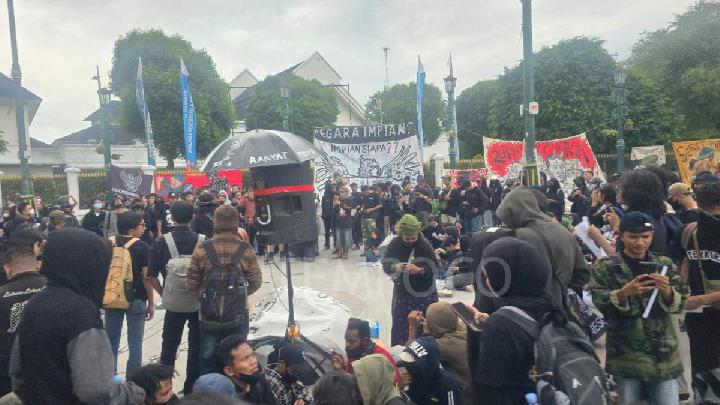
TEMPO.CO, Jakarta - As dusk fell on Thursday, March 20, 2025, the courtyard of the Yogyakarta Special Region Legislative Council (DPRD) building on Malioboro Street turned into a staging ground for outrage. Tents went up between flagpoles. Banners stretched across the iron fence. In one corner, poetry was recited. In another, street theater played out. Hundreds of people—students, lecturers, activists, journalists and mothers—gathered to protest the passage of revisions to the Indonesian National Armed Forces (TNI) Law.
From midday, crowds arrived in waves. They did more than deliver speeches they turned that space into a platform for expression. The red-and-white Indonesian flag was lowered to half-staff. Music, poems and posters depicting soldiers stood alongside small discussions between tents. A single demand echoed again and again: repeal the TNI Law.
The House of Representatives (DPR) passed the revised TNI Law that same day on March 20, 2025. For many civil society groups in Yogyakarta, its passage marked a setback for democracy. They said the deliberations were conducted behind closed doors, without meaningful public participation, and reopened the door for the military to take civilian posts.
Vincentius Dandhy, a spokesperson for Aliansi Jogja Memanggil (Jogja Calling Alliance), one of the key drivers of the protests, said the people were disappointed by a closed-door legislative process that excluded meaningful participation. "This law expands the military's authority beyond defense matters," he told Tempo on Tuesday, December 23, 2025. "With the military's hierarchical character and its rigid chain of command, this is dangerous for democracy."