Indonesia Faces Megathrust Threat as 200-Year Cycle Nears End
Reporter
May 7, 2026 | 04:00 am

TEMPO.CO, Jakarta - The Indonesian Association of Disaster Experts (IABI) has brought up research results estimating the potential of a megathrust earthquake recurring every 200 years. According to several studies, there are specific areas that should have already entered this cycle or experienced a significant earthquake, but have not done so to date.
"There have been numerous studies on megathrust earthquakes, and it seems that at least two or three locations should have experienced a Megathrust earthquake in this 200-year cycle," stated the Board Member of IABI, Dwikorita Karnawati, during a forum at Muhammadiyah University of Yogyakarta (UMY) on Wednesday, May 6, 2026.
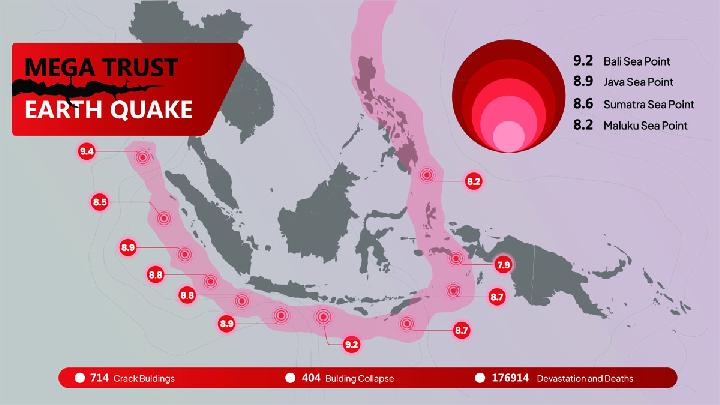
Dwikorita explained that the two or three most frequently mentioned locations expected to experience a megathrust earthquake cycle are Mentawai or Siberut Island on the west coast of Sumatra, the southern part of the Sunda Strait, and the southern part of the Special Region of Yogyakarta (DIY). Citing research data from the Bandung Institute of Technology (ITB), Dwikorita pointed out that the 200-year cycle of the megathrust earthquake has entered its final 30 years.
Former Head of the Meteorology, Climatology, and Geophysics Agency (BMKG), who is also a Professor of Environmental Geology and Disaster Mitigation at Gadjah Mada University (UGM), added that despite the uncertainty of the exact time, it is urgently necessary to take mitigation measures. "We are not trying to scare anyone, and this is not a prediction but the result of research studies," said Dwikorita, emphasizing the need to use research as the basis for mitigation.
Facing such potential threats, Dwikorita believes that several local governments are prepared. She cited the example of the DIY Government, especially through the special design of the Yogyakarta International Airport (YIA). The airport's structure is capable of withstanding earthquake tremors of up to Magnitude 8.7. This design is based on the success of Sendai Airport in Japan, which remained standing strong with no casualties during the Megathrust earthquake due to its infrastructure readiness.
Dwikorita elaborated that YIA is not just a transport infrastructure but also a well-thought-out tsunami evacuation fortress. The airport area has been raised 7-10 meters to counter potential tsunami waves. Although the ground floor may be submerged, the mezzanine and second floors have been prepared to accommodate around 10,000 people as evacuation areas, in addition to a crisis center in the form of a tower that can accommodate 2,000 local residents.
"YIA is possibly the only airport in ASEAN that has prepared to face the potential megathrust earthquake," she said. In addition to the physical structure, the airport's security system is also equipped with special barriers on the underpass route that automatically close when the earthquake siren sounds, directing vehicles towards the safe area in the airport terminal.
Dwikorita cautioned against complacency among the population and authorities regarding the current level of preparedness. She also highlighted the challenge of sustaining education, considering the turnover of student generations in schools and the turnover of regents and government officials.
She also stressed the need for intensive and continuous disaster preparedness training and drills to ensure that mitigation knowledge is not lost when trained personnel graduate or change positions. "So, the current challenge lies in terms of preparedness, in addition to the drills needing to be more intensive, it's about sustainability," she said.
The Secretary-General of the National Disaster Management Agency (BNPB), Rustian, believes that there is still a gap between the quality of disaster management policies at the national level and their implementation in the regions. He mentioned three main issues that are the root cause of this gap. First, the early warning system is not fully integrated end-to-end. Second, the cross-sector risk data integration is still not optimal. Third, the capacity of local governments to respond tactically and operationally to emergencies is still considered weak.
He pointed out that this situation directly impacts the fragility of basic government services when disasters occur. The major floods and landslides that hit Aceh, North Sumatra, and West Sumatra in late November 2025 are cited as real examples of this issue.
Rustian believes that these events serve as a reminder that disaster risks in Indonesia are now systemic and multidimensional, especially due to the interaction of various threats exacerbated by climate change. "National-level coordination readiness does not automatically enhance tactical and operational preparedness at the local level," he said.
Read: Fact Check: BMKG Never Announced a 2026 Megathrust Earthquake Across Indonesia
Click here to get the latest news updates from Tempo on Google News