Fact Check: Is Indonesia a Pioneer in Social Media Ban for Children?
Reporter
April 8, 2026 | 11:08 am
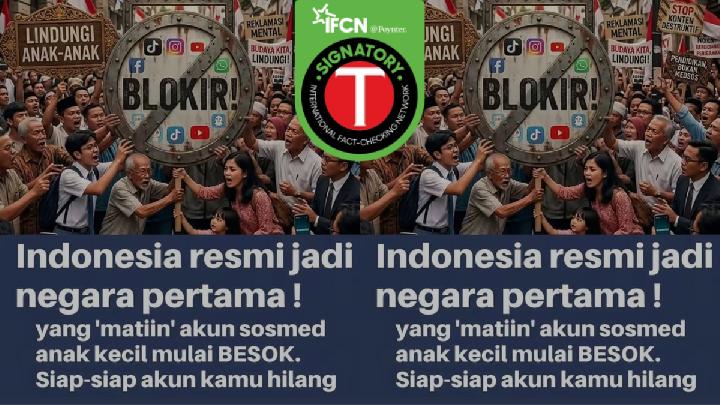
TEMPO.CO, Jakarta - Several accounts on social media platforms like Facebook [archive], TikTok, and YouTube have been spreading claims that Indonesia is the first country to ban social media access for children since late March 2026.
The post includes an illustration of several people holding up posters in support of the Minister of Communication and Digital Regulation Number 9 of 2026. The regulation is claimed to prohibit children under the age of 16 from accessing social media starting March 28, 2026. "Indonesia officially becomes the first country to 'shut down' children's social media accounts starting tomorrow. Get ready to lose your accounts," the caption on the poster reads.
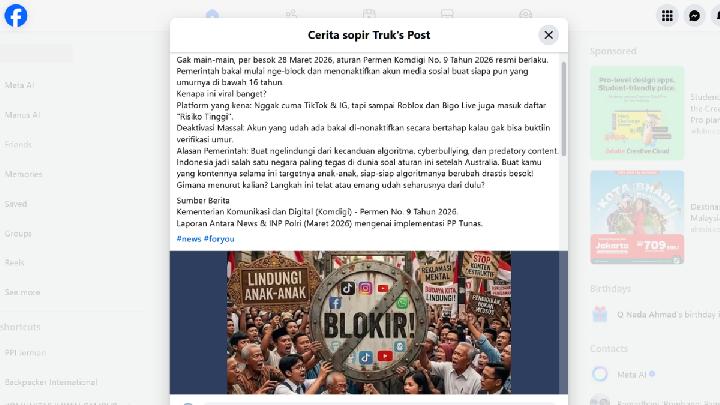
But is Indonesia really the first country to adopt a sweeping social media ban for children?
FACT CHECK
Tempo's verification results show that Indonesia is indeed the first country in ASEAN to impose restrictions on social media access for children under 16. But globally, Indonesia is not a pioneer in this policy, as several other nations have drafted similar regulations.
This conclusion is based on a comparison of various credible media reports regarding similar regulations in several other countries. Indonesia follows the steps of several countries that have previously drafted or implemented social media bans for children's cybersecurity and mental health.
In its implementation, the government has requested at least eight digital platforms to comply with the new regulations. This includes YouTube, TikTok, Facebook, Threads, Instagram, X, Bigo Live, and Roblox.
Australia Pioneers Social Media Restrictions for Children
A report by The Guardian places Australia as the first country in the world to impose a sweeping ban on social media access for children. The country passed the law in 2024, which entered into force in December 2025.
Platforms targeted by this regulation include Facebook, Instagram, Threads, X, YouTube, Snapchat, Reddit, Kick, Twitch, and TikTok.
Following Australia's move, the Indian state of Karnataka also banned social media use for children under 16. Citing a Reuters report, the policy officially took effect on March 6, 2026.
Brazil also tightened digital oversight through the Children and Adolescents Safety Act, which took effect on March 17, 2026. Through this policy, the Brazilian government requires users under 16 to link their accounts to a legal guardian. The regulation also prohibits addictive features such as infinite scrolling mechanisms.
Social Media Bans Spark Controversy
Several countries claim to protect children from digital risks when imposing social media restrictions. However, UNICEF believes such regulations risk backfiring because they can cut off children's access to information and the outside world beyond their immediate environment.
Other negative impacts include the potential for children to access social media through illegal channels, share devices clandestinely, and switch to new, unregulated platforms. UNICEF recommends that governments and technology firms work together to build a digital space that is safe, inclusive, and respects children's rights.
The UN agency's publication emphasized that age-restricted regulations should not displace companies' obligations to invest in safe platform design and effective content moderation.
"Authorities must ensure that age-related laws and regulations do not replace companies’ obligations to invest in safer platform design and effective content moderation," the document read.
Amnesty International Indonesia's Executive Director, Usman Hamid, also criticized the social media ban. He believed this regulation has the potential to deprive tens of millions of young people of their right to communicate, access information, develop their creativity, and express themselves.
"This sweeping ban on social media will deprive tens of millions of young people in Indonesia of their right to communicate with others, access information, develop their creativity, and express themselves," Usman said in an official statement on Monday, March 9, 2026.
Usman noted that social media has long been a crucial platform for young people to express their opinions on public policy, including the Free Nutritional Meal Program. Without such access, it will be increasingly difficult for children to voice their opinion on policies that directly impact their lives.
CONCLUSION
Tempo's investigation concludes that the narratives claiming that Indonesia is the first country to restrict social media for children under 16 are partially true.
At the ASEAN level, Indonesia was indeed the first country to implement such a regulation. However, globally, Australia was the earliest country to initiate such a policy, starting in late 2025.
TEMPO FACT-CHECK TEAM
**Do you have information or claims that you want to have fact-checked? Contact our ChatBot. You can also send criticism, objections, or feedback for this Fact-Checking article via email to [email protected].