Academics Warn of Remilitarization in Indonesia Under Prabowo
Reporter
May 31, 2026 | 06:46 am
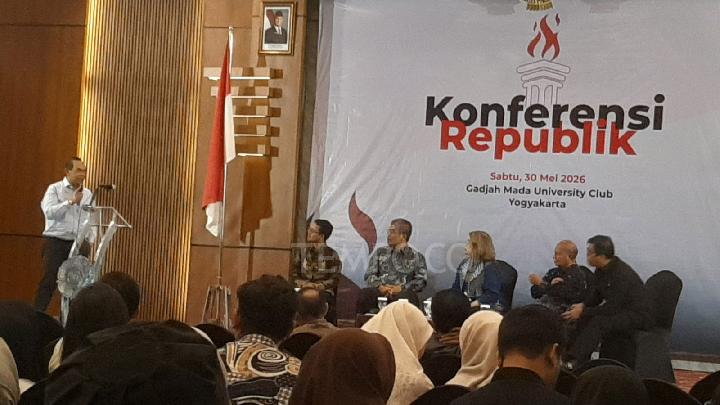
TEMPO.CO, Jakarta - Hundreds of academics, activists, civil society organization activists, and communities consolidated at the University Club of Gadjah Mada University (UGM), Yogyakarta, Indonesia, on Saturday, May 30, 2026. The forum took place to respond to the strengthening of the military as part of the decline of the democracy of President Prabowo Subianto and Vice President Gibran Rakabuming Raka's government.
Remilitarization became one of the topics discussed in the consolidation titled Republic Conference Strengthening Civil Society Pillar of the Republic. In addition to the strengthening of militarism, they discussed various crucial issues including economic inequality, crisis of representation and democracy, weakening of social base, and legal and institutional crises.
The consolidation, which lasted for one day, involved several speakers, including Jaleswari Pramodhawardani, Yanuar Nugroho, Zainal Arifin Mochtar, Arie Sujito, Alissa Wahid, Bhima Yudistira, Candra Hamzah, Titi Anggraini, Andi Wijayanto, Leo Kleden, Baiquni, Gita Wirjawan, Komaruddin Hidayat, Komaruddin Hidayat. Also present at the meeting was the founder of Saiful Mujani Research and Consulting (SMRC) Saiful Mujani.
UGM Sociologist, Arie Sujito, said that the meeting was an accumulation of academic and activist anxieties due to the economic and political crises. The consolidation became an alternative movement to oversee the democratic process, an idea that emerged due to shared concerns. "Let's not allow democracy to further deteriorate. Academics, activists, organization activists, and critical journalists need to continue to consolidate," said Arie.
Arie mentioned that in the three decades since the reform began, democratization has experienced inevitable pressures and fluctuations. Indonesia faces far more complex, fluid, and often silent challenges within formal legal corridors.
According to Arie, Indonesia also faces democratic regression or the decline of democracy according to political scientists' findings. This is marked by various practices of terror reproducing neo-authoritarianism.
He highlighted remilitarization as a crucial factor causing the weakening of democracy. The military enters through various government agendas through a number of top-down programs, charitable or voluntary activities, and various strategies to subdue the elite, middle, and lower classes. "This is a form of regression of the reform agenda and threatens democracy," he said.
Head of the Indonesia 2045 Laboratory Jaleswari Pramodhawardani stated that militarization hinders Indonesia from building institutions. The Indonesian National Military (TNI) is now in the public sphere in a subtle way through presidential regulations and instructions.
Jaleswari gave examples of the presence of combat battalions and territorial construction battalions that deviate from the constitutional mandate, namely the TNI as a defense force. "The TNI is currently encroaching into civilian areas," said the former Deputy V for Politics, Law, Defense, Security, and Human Rights at the Presidential Staff Office.
Read: Prabowo Taps Agus Harimurti as High-Speed Rail Committee Chief
Click here to get the latest news updates from Tempo on Google News